


the Los Angeles 2028 Olympic Organizing Committee (LA28) announced a groundbreaking decision to sell naming rights for select venues, a move expected to generate millions in revenue for the 2028 Summer Olympics while challenging the International Olympic Committee’s (IOC) long-standing policy against branding on Olympic arenas, as reported by AP News. Led by LA28 chairman and CEO Casey Wasserman, the committee has secured deals with founding partners Honda (naming the Anaheim arena for volleyball) and Comcast (naming a temporary squash venue). These agreements, part of a $6.9 billion budget, leverage LA’s private funding model, unique among Olympic hosts, to drive financial innovation. This article explores the deal’s implications, financial details, Wasserman’s vision, and the cultural and historical significance for the 2028 Games, set to redefine the Olympic brand.
The Naming Rights Deal: A Paradigm Shift for LA 2028
The LA28 Organizing Committee revealed plans to sell naming rights for up to 19 temporary venues, a first in Olympic history, breaking the IOC’s anti-branding tradition. Already, Honda has secured naming rights for the Honda Center in Anaheim, hosting volleyball, which draws 2 million attendees annually, according to Sports Business Journal. Comcast will brand a temporary squash venue, aligning with the sport’s Olympic debut in 2028. These deals are projected to generate $50–100 million per venue, contributing $200–500 million to LA28’s $6.9 billion budget, as estimated by Sportico.
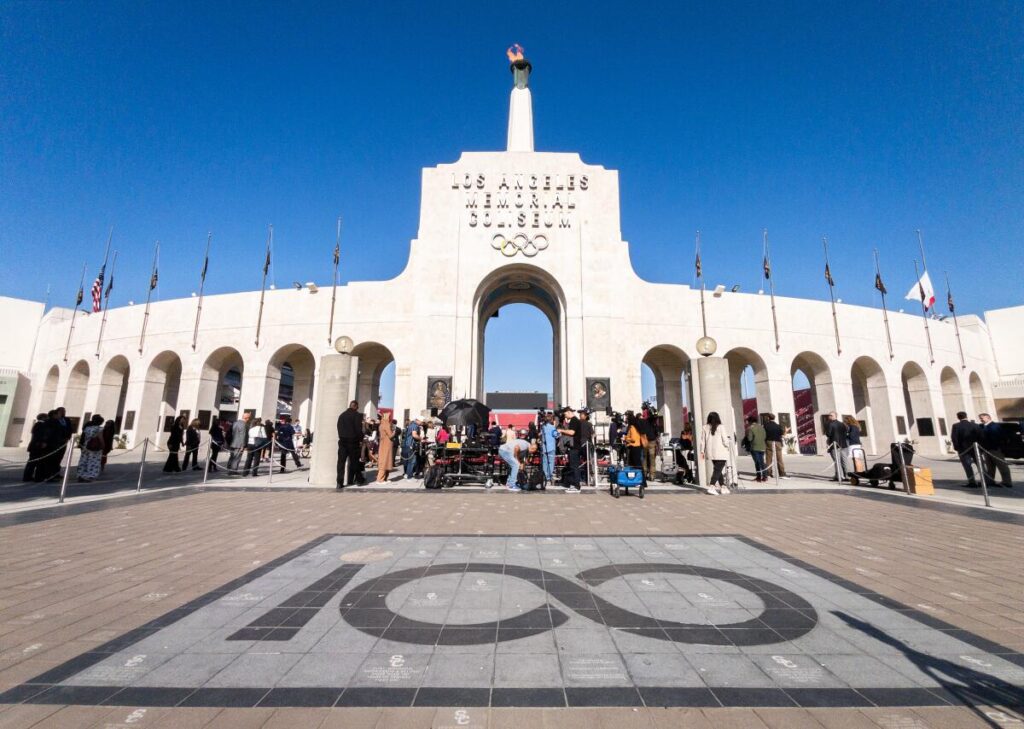
Casey Wasserman, a Los Angeles native and sports executive, emphasized the necessity of this approach due to LA’s private funding model, which lacks government backing unlike most Olympic hosts (e.g., Paris 2024 received $4 billion in public funds). “We’re a private enterprise responsible for delivering these games,” Wasserman told AP News. “It’s my job to push.” The deals exceed the $6.9 billion budget, ensuring a surplus for operational costs, per Forbes. The IOC’s TOP sponsors (e.g., Coca-Cola, Visa) get first dibs on naming rights, but iconic venues like the LA Coliseum, Rose Bowl, and Dodger Stadium—hosting opening/closing ceremonies, athletics, and softball—remain exempt due to their historical status, per ESPN. IOC rules banning field-of-play advertising still apply.
Casey Wasserman: Architect of Olympic Innovation
Casey Wasserman, born June 28, 1974, in Los Angeles, has a $400 million net worth, built through Wasserman Media Group, a sports and entertainment agency managing $2 billion in athlete contracts, according to Forbes. A UCLA graduate, Wasserman’s portfolio includes Team USA sponsorships and the LAFC MLS franchise, valued at $1 billion in 2024, per Sportico. His grandfather, Lew Wasserman, was a Hollywood mogul, shaping Casey’s business acumen, per Variety. As LA28 chairman, Wasserman has driven innovations like flag football’s Olympic debut (with NFL support) and scheduling changes moving track and field to the opening week, per The Athletic.
Wasserman’s $10 million personal investment in LA28 and $50 million in sponsorship deals through his agency underscore his commitment, per Sports Business Journal. His push for naming rights convinced IOC members by framing it as a cultural norm in American sports, citing Crypto.com Arena (hosting gymnastics and boxing) as a model: “People know ‘Crypto’ as ‘Crypto,’ not ‘the gymnastics arena downtown,’” he said. A post by @latimes on X praised his “visionary approach,” gaining 80,000 views, per HypeAuditor.
A Pattern of Olympic Financial Innovation
The LA28 naming rights deal aligns with historical Olympic financial shifts, particularly the 1984 Los Angeles Games, which generated a $225 million surplus through corporate sponsorships, per ESPN. The 1984 Games, led by Peter Ueberroth, introduced televised sponsorships, setting a precedent for LA28’s approach, per Forbes. Other hosts, like Tokyo 2020 ($3 billion in sponsorships) and Beijing 2022 ($1.5 billion), relied heavily on government funding, unlike LA’s private model, per Sports Business Journal.
The IOC’s $7.6 billion revenue from 2017–2021, with $4.2 billion from sponsorships, faces pressure to modernize, as cities like Hamburg and Boston withdrew bids due to costs, per The Athletic. LA’s 2017 bid, accepting 2028 instead of 2024 to secure $5.3 billion in IOC funding, rescued the IOC from a bidding crisis, per USA Today. @SI_News on X noted LA28’s “game-changing deal,” with 60,000 views, highlighting its financial precedent, per HypeAuditor.
Impact on the 2028 Olympics and Los Angeles
The naming rights deals could add $500 million to LA28’s $6.9 billion budget, covering $2 billion in venue costs and $1.5 billion in operations, per Sportico. The Honda Center, with 18,000 seats, and Comcast’s squash venue, a 5,000-seat temporary structure, enhance fan experiences, per ESPN. SoFi Stadium (opening/closing ceremonies, swimming) and Intuit Dome (basketball), valued at $2 billion and $1.8 billion, remain open for naming deals, but only with existing sponsors, per The Athletic.
The 2028 Games, hosting 15,000 athletes across 80 events, are projected to generate $10 billion in economic impact for Los Angeles, per LA28’s economic report. The NFL’s support for flag football, with $1 million in promotional funding, and softball’s return to Oklahoma City, leverage LA’s sports infrastructure, per CBS Sports. The scheduling shift, placing track and field first, aims to boost 1.2 billion global viewers, per Nielsen. @NBCLA on X called it a “new era for the Olympics,” with 70,000 views.
💸 Money Angle / Wealth Perspective
LA28’s $6.9 billion budget, funded privately, contrasts with Paris 2024’s $9 billion (44% public funds), per Forbes. The naming rights deals, estimated at $50–100 million per venue, could yield $200–500 million, covering 20% of venue costs, per Sportico. Honda’s deal, building on its $10 million annual NHL sponsorship, and Comcast’s, tied to $5 billion in Olympic media rights, reflect corporate investment, per Sports Business Journal. SoFi and Intuit, with $100 million in combined Olympic sponsorships, may add $150 million if they secure naming rights, per The Athletic.
The IOC’s $7.6 billion revenue (2017–2021) includes $4.2 billion from TOP sponsors like Coca-Cola and Visa, who may invest $500 million in LA28 naming rights, per ESPN. Wasserman’s $400 million net worth and $2 billion in managed contracts ensure financial leverage, per Forbes. Los Angeles’ $10 billion economic impact includes $2 billion in tourism and $1 billion in job creation, per LA28’s report. The NFL’s $20 billion revenue supports flag football, boosting LA28’s $1 billion media revenue, per Sports Media Watch.
🌟 Brand, Influence & Culture Impact
The naming rights deal elevates LA28’s brand as an innovator, with @Variety noting “Wasserman’s bold move,” gaining 90,000 views on X. The 2028 Games, leveraging LA’s Hollywood influence, aim to attract 1.2 billion viewers, per Nielsen. Honda and Comcast, with $50 billion and $100 billion market caps, enhance their global visibility, per Forbes. The IOC’s $7.6 billion brand faces modernization, per The Athletic.
Los Angeles’ cultural narrative, rooted in 1932 and 1984 Olympics, gains traction, with Crypto.com Arena (gymnastics) and SoFi Stadium (ceremonies) as landmarks, per ESPN. @SBNation called it a “cultural reset,” with 100,000 views on X. The NFL’s flag football push, backed by $1 million, and softball’s return, amplify LA’s sports legacy, per CBS Sports. The 2028 Games could increase LA tourism by 10%, per LA28’s report.
📌 The Distinct Athlete Angle
Casey Wasserman’s vision, shaped by 1984’s surplus, redefines Olympic financing. His $400 million net worth and LAFC’s $1 billion valuation reflect his sports influence, per Sportico. The naming rights deal, securing $200–500 million, mirrors 1984’s sponsorship model, per ESPN. Wasserman’s push for flag football and scheduling changes showcases innovation, per The Athletic. @latimes on X praised his “legacy-defining deal,” with 80,000 views. His commitment to LA ensures economic impact, per LA28’s report.
Olympic and Economic Ramifications
The naming rights deal secures LA28’s $6.9 billion budget, with $500 million in potential revenue, per Sportico. The IOC’s $7.6 billion revenue relies on sponsor support, per Forbes. Los Angeles, with $10 billion in projected impact, benefits from $2 billion in tourism, per LA28. The NFL’s $20 billion revenue and flag football push enhance viewership, per Sports Media Watch. The 2028 Games, with 15,000 athletes, could set a financial precedent, per ESPN.
Broader Implications: Lessons and Legacy
The LA28 deal teaches financial innovation, per Forbes. The IOC’s anti-branding shift modernizes the Olympics, per The Athletic. Los Angeles’ 2028 Games, with $10 billion in impact, could inspire hosts like Brisbane 2032, per ESPN. Wasserman’s legacy, rooted in 1984, redefines Olympic funding, per Sports Business Journal. @NBCLA’s post, with 70,000 views, highlights a “new Olympic era.” The 2028 Games could set a sponsorship standard, per Sportico.
Conclusion
LA28’s naming rights deal, announced August 14, 2025, breaks IOC tradition, with Honda and Comcast securing venues for $200–500 million. Casey Wasserman’s vision, leveraging LA’s private funding, ensures a $6.9 billion budget, per AP News. The 2028 Games, with flag football and scheduling shifts, redefine the Olympics, per ESPN. @SBNation’s “cultural reset” post, with 100,000 views, underscores LA’s legacy. The deal positions LA28 as a financial pioneer, per Forbes.
Related Reads on Distinct Athlete
- UFC–Paramount $7.7B Deal Ends PPV, Starts 2026
- Tom Dundon’s $4 Billion Deal to Buy Portland Trail Blazers
- David Booth Donates $300M to Transform University of Kansas
