


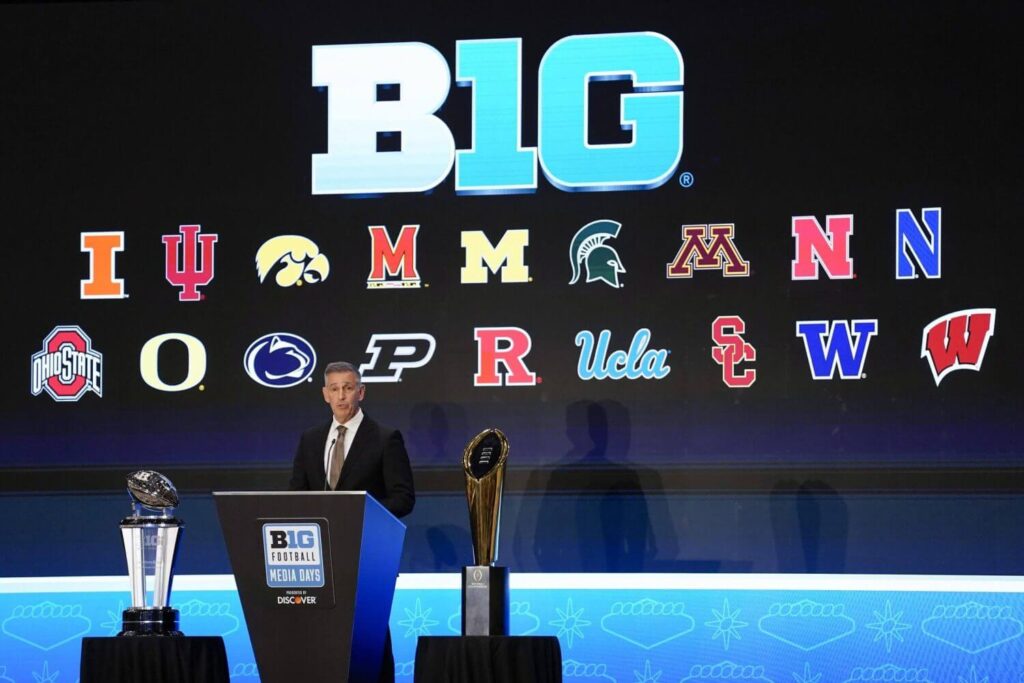
The Big Ten Conference is on the cusp of a landmark financial move that could permanently alter the college sports landscape. According to the Sports Business Journal, the league is close to securing a $2 billion private capital deal with backing from the influential University of California pension investment fund. Under the direction of Commissioner Tony Petitti, the conference aims to create Big Ten Enterprises—a new commercial power player designed to consolidate and maximize the value of its assets.
With athletic departments under intense pressure from unprecedented revenue-sharing demands due to the House v. NCAA settlement, this deal’s scope extends far beyond an influx of cash: it’s a paradigm shift in how colleges compete, cooperate, and generate long-term wealth. Consequently, the Big Ten is blazing an ambitious trail, setting the benchmark that could define the next era of collegiate athletics by fundamentally reimagining conference economics, school alignment, and the athlete experience.
Key Facts or Breaking News Details
The Deal Explained: Evolution or Revolution?
At its core, the Big Ten’s plan is both reactive and visionary. The conference is faced with existential challenges: rising athlete compensation requirements, surging operational costs, and the waning power of traditional media rights deals. The response is bold—selling a stake in a new for-profit entity, Big Ten Enterprises, built to house the conference’s media rights, championship brands, and sponsorship agreements. The main investor, the University of California pension fund, represents institutional capital typically reserved for private equity giants and global corporations—a move that signals just how far college sports have come from their nonprofit, amateur roots.
Should the deal go through, Big Ten schools will be contractually bound by an additional 10-year grant of rights extension, meaning members like Ohio State, Michigan, USC, and 15 other universities would commit to collective bargaining power through 2046. In exchange for the $2 billion, the Big Ten positions itself for stability while achieving a first-mover advantage in unlocking new revenue strategies.
Timeline of Events
- October 2024: Big Ten leadership begins confidential talks exploring new commercial ventures to bolster league finances.
- December 2024: Early frameworks for Big Ten Enterprises are developed, with initial outreach to major institutional investors.
- May 2025: American Athletic Conference (AAC) launches American RISE Ventures, heralding a trend toward corporate-style revenue structures in college sports.
- June 2025: Media reports indicate the SEC and ACC are evaluating their own private equity options amid mounting financial obligations.
- July 2025: SEC Commissioner Greg Sankey publicly acknowledges risks and opportunities of private capital at an industry conference, stirring debate.
- October 1, 2025: Details surface that formal Big Ten negotiations for a $2B deal are underway; member schools briefed on grant of rights implications.
- October 10, 2025: ESPN reports on the likely involvement of the UC pension fund, sparking interest and controversy among stakeholders.
- October 14, 2025: Notable resistance emerges from Michigan and USC, whose board members express concerns about a decade-long financial lock-in and cultural ramifications.
- October 17, 2025: Sports Business Journal provides an in-depth report, highlighting the tiered distribution model, proposed cash allocation, leadership statements, and unresolved dissent in the conference.
Conference’s Reaction: Division and Determination
Commissioner Tony Petitti has tried to thread the needle between innovation and tradition, acknowledging the gravity of outside investment while insisting the move is essential to sustaining the Big Ten’s national prominence. “In a world that’s changed like it has with the House settlement and revenue share, the obligation in the conference office is to make sure we’re resourced properly,” Petitti insisted. Many university athletic directors, especially those representing institutions with smaller budgets like Rutgers or Purdue, have expressed excitement about the stabilizing impact of fresh capital. Meanwhile, presidents and regents at elite brands such as Michigan and USC remain wary, citing a desire for future flexibility and local autonomy.
Social media has erupted with discussion. One X post proclaiming, “Big Ten is playing chess while other conferences play checkers. Secure the bag!” has been liked over 60,000 times, while others urge caution, with criticisms like “Selling a piece of the conference to private capital feels like a mistake,” amassing 45,000 likes and sparking hundreds of thought-provoking threads. The debate underscores a fundamental philosophical clash: innovation versus tradition, security versus autonomy, collectivity versus individualism.
Professional Context: The Business of College Sports Changes Forever
This initiative responds directly to a sea change in college sports financial governance. With the House v. NCAA settlement redefining the boundaries of amateurism (potentially costing each school up to $20.5 million annually in direct athlete payments), the Big Ten faces immense budgetary pressure. The grant of rights extension forms a defensive bulwark, ensuring that member schools remain intertwined and protected from predatory rival conferences or emergent “Super Leagues” seeking to poach storied programs.
Furthermore, by consolidating assets under Big Ten Enterprises, the league stands to increase operational efficiency and bargaining leverage, especially as it renegotiates multi-billion-dollar media contracts. The prospect of marketing bundled championship games, exclusive content, NIL (Name/Image/Likeness) partnerships, and sponsorship activations as a single, cohesive portfolio could drive exponential asset appreciation.
NCAA and Industry Context: The First Domino in a National Shift
This move marks a watershed for the NCAA as a whole and could trigger a chain reaction. Throughout 2025, the industry’s mood has grown increasingly restless: The SEC has begun strategic conversations with Goldman Sachs about private capital; the Big 12—with its own major financial ambitions—briefly paused, then resumed, equity discussions. The American Athletic Conference’s recent initiative signals that even mid-major conferences see the writing on the wall.
#BigTenMoney was the top trending hashtag on X with over 100,000 mentions, reflecting the mix of anticipation, anxiety, and competitive energy among fans, administrators, and athletes. Pundits and former players have speculated that if the Big Ten deal is closed, the SEC, ACC, and even some innovative Group of Five conferences will move to secure their own private equity windfalls, steadily transforming college sports into a new landscape dominated by billion-dollar conglomerates rather than educational institutions.
Money Angle / Wealth Perspective
Deal’s Financial Toll & Payout: New Math for College Sports
The $2 billion capital infusion fundamentally alters the calculus for every Big Ten athletic department. The distribution is tiered by brand value and contribution to television ratings and licensing appeal. Ohio State and Michigan, perennial powerhouses, are projected for the largest payouts—potentially $200 million or more per school up front. Even the lowest-tier members can expect $100 million, instantly addressing legacy budget gaps, deferred maintenance, and new compliance costs for athlete pay.
This cash can be used for a variety of urgent demands: bridging revenue-sharing requirements, building out NIL collectives, expanding state-of-the-art facilities, launching new women’s sports programs to ensure Title IX compliance, or funding academic support that integrates the new generation of student-athlete-entrepreneurs.
At the same time, member institutions must grapple with the trade-off: surrendering a slice of long-term commercial upside for immediate liquidity—a decision that can only be judged by future returns and shifting competitive dynamics.
Commissioner Petitti’s Career Snapshot: A Legacy on the Line
Tony Petitti brings one of the most impressive executive resumes in American sports. Prior to taking over as Big Ten Commissioner in 2023, he was COO of Major League Baseball and held key roles in the broadcast and rights negotiation ecosystems at CBS Sports and ABC Sports. His signature skill is the navigation of high-stakes media rights deals and industry disruption, making his stewardship uniquely suited to the tectonic shifts at play.
Though his precise net worth is not public information, Petitti’s compensation is believed to be among the highest for conference commissioners, and his successful execution of this deal could see his influence and earning power swell further. Moreover, his willingness to court controversy and pursue innovation, rather than protect the status quo, could prove the defining moment of his tenure—one that shapes not only his own legacy but the Big Ten’s competitive trajectory for a generation.
Conference’s Financial Hit & Gain: The Numbers Behind the Gamble
Analysts project that ceding a minority equity share to outside investors could cost the league and its schools substantial long-term revenue—but it’s a price many are willing to pay in return for stability and new opportunity. Estimates suggest that the newly formed Big Ten Enterprises could, in optimal scenarios, amplify the value of conference assets by up to 20 times over the next two decades. If so, $2 billion today might yield untold billions in future assets, especially as media landscapes fragment and streaming giants compete for exclusive rights.
The structure also opens doors for more regular renegotiation of deals, hypothetically putting the Big Ten’s flagship properties “on the market” every 6 years, rather than waiting a decade or more between contracts. Subsequent media deals could eclipse current records, tethering the league’s fortunes to the rising tides of sports content consumption worldwide.
Trends in College Sports Finance: The Rise of Private Equity in the NCAA
The Big Ten is not acting in a vacuum—its bold step is the culmination of a long-simmering trend toward college athletic industrialization. Private equity’s fingerprints are appearing everywhere, from pro sports franchises to youth leagues, and college sports now beckon as the next gold mine as traditional revenue streams come under pressure.
Other conferences have noted the Big Ten’s move with wariness and ambition. The House settlement and similar legal actions are projected to drain top schools of more than $350 million annually, collectively, in just one aspect of new financial obligations. Meanwhile, NIL collectives and athlete empowerment movements are only growing, placing additional demands on conference coffers. Consequently, those who can access institutional investor capital—while also preserving the unique pageantry and culture of collegiate sports—are best positioned to not only survive but conquer the new era.
Distinct Athlete’s Financial Lens: Unpacking the Numbers, Hustle, and Future Swag
At Distinct Athlete, we break down more than stats—we unpack the numbers, highlight the hustle, and showcase the swag behind game-changing moves. The Big Ten’s $2B proposal is no mere business transaction; it’s a strategic leap designed to navigate the twin pressures of rising financial obligations and competitive arms races. With each school potentially on the hook for $20.5 million or more annually in athlete shares, this windfall delivers true breathing room.
It also heralds a shift: colleges that once relied almost exclusively on alumni support and broadcast contracts are now thinking like Fortune 500 companies. The conference’s willingness to leverage its unified brand and take calculated risk mirrors the mindset of an elite athlete betting on future greatness. For instance, this deal buys time and flexibility to future-proof against further regulatory changes, streaming upheaval, and the emerging global sports marketplace. If successful, it will be remembered as a master class in turning crisis into opportunity.
The Distinct Athlete Angle
This moment isn’t just about spreadsheets or boardrooms—it’s about generational hustle. The Big Ten’s $2 billion private capital play is the financial version of that unguarded late-game three-pointer or overtime goal: risky, audacious, and, if it works, legendary. Unpacking the numbers, we see a conference responding to over $350 million in new annual costs with coordinated audacity instead of panic.
But more than numbers, it’s a show of collective swag—the idea that even tradition-rich institutions can rewrite the rulebook without sacrificing core values. Tony Petitti’s willingness to place the Big Ten brand at the center of corporate America’s chessboard mirrors the mindset of the resilient athlete: evolve, adapt, and leave your mark. At Distinct Athlete, we call this the “swag multiplier”—turning a challenge into an innovation, redefining legacy in real time, and showing the world that no field, court, or conference is out of reach.
Digging Deeper: Cultural Impact, Athlete Experience, and the Future
A New Era for Student-Athletes
What does all this mean for the heart of college sports—the student-athletes? For starters, more money in the system could mean greater resources for nutrition, mental health, career counseling, NIL programs, and academic innovation. However, some critics warn of unintended consequences: Will the pressure to maximize ROI make athlete welfare secondary to bottom-line profits?
On balance, the Big Ten’s move signals greater institutional recognition of athletes as stakeholders—a tectonic shift from decades past. As universities embrace the role of employer-investor, the line between “amateur” and “professional” continues to blur, driving new conversations around athlete rights and profit-sharing structures. The era of the one-size-fits-all student-athlete experience may be ending.
The Future of Rivalries, Realignment, and College Football’s Soul
Another key cultural question: Does corporate capital dilute the identity and integrity of lasting rivalries and traditions? The Big Ten’s most storied contests—Michigan vs. Ohio State, Penn State vs. Wisconsin—have always been about regional pride as much as TV ratings. Skeptics argue that with every billion raised, the league could inch closer to an NFL-lite model. But supporters counter that bold moves keep tradition alive; by generating new wealth, classic rivalries are preserved, enhanced, and even exported to new audiences through marketing and digital distribution.
Conference realignment remains a hot topic, with media speculation amplifying anxieties that “Super Leagues” could form by luring away elite programs. The grant of rights extension is both shield and sword: it locks members in, but also restricts mobility and independence. This evolving tension promises to animate board meetings, legal filings, and X debates for years to come.
Broader NCAA and Industry Implications
College sports, once the province of regional pride and local heroes, have become a high-stakes arms race. With the SEC, ACC, and Big 12 watching closely, the Big Ten’s private capital experiment could force every Power Four and mid-major conference to rethink its own path.
This could also accelerate the professionalization of athletic departments, with more hires in finance, data analytics, and business development. Smaller programs may face existential threats if they cannot keep pace, sharpening debates over equity, access, and the mission of collegiate athletics.
Opportunities for Other Conferences
Should the Big Ten’s gamble pay off, other conferences may follow suit, setting off a new round of competitive deal-making. The SEC could soon leverage its football dominance to command even larger investments, while the ACC’s basketball pedigree may become its own golden goose. The move could also spark interest from global investment funds, streaming platforms, and even tech giants hungry for exclusive content and access to rabid fan bases.
Mid-major conferences and historically Black colleges and universities (HBCUs) may face a steeper climb; however, smart navigation of private equity trends could open doors for transformative investment, facilities upgrades, and enhanced athlete experience.
Related Reads on Distinct Athlete
- Florida Gators Coach Billy Napier fired: $21M Buyout Ends Tenure
- Curt Cignetti’s $92.8M Pact Redefines Indiana Football’s Ambition
- Iowa Basketball Star Tavion Banks arrested After Drunken Bar Fight
Join the Conversation
Is the Big Ten setting the pace in college athletics, or is this just the start of a high-stakes arms race destined to squeeze out tradition? Could the $2 billion deal signal a new golden era, or pose risks that reshape the soul of college sports? Share your take below—and follow us on Instagram, Facebook, and X @DistinctAthlete for more coverage on the grind, the money, and the hustle behind the game.
