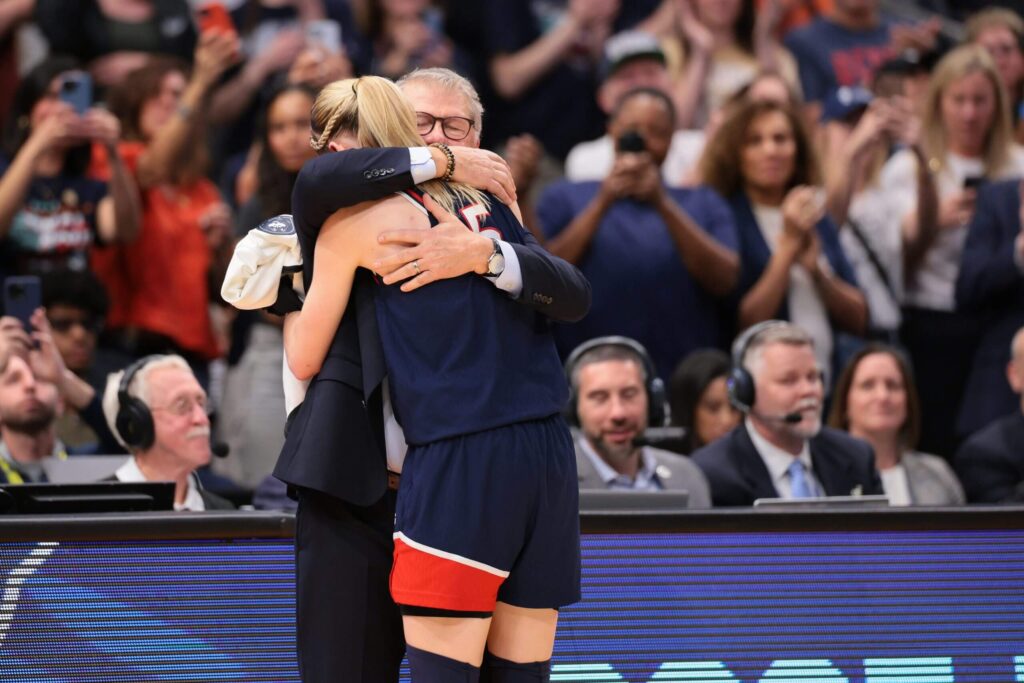


🏀 Lead ParagraphAt a moment when **women’s college basketball is carrying more ratings power, sponsor attention, and cultural momentum than ever**, even a brief sideline tension between iconic coaches can become bigger than the game itself. That is why **Paige Bueckers addressing the “unfortunate” moment involving Geno Auriemma and Dawn Staley at the Women’s Final Four** landed with weight far beyond a routine postgame comment. This was not just a player cleaning up a headline. It was one of the sport’s most visible stars stepping into a conversation about leadership, optics, respect, and the business reality of what happens when women’s basketball is no longer a niche product but a major entertainment property. In today’s media economy, every exchange is content, every reaction shapes brand equity, and every public figure attached to the women’s game is operating inside a larger ecosystem of money, influence, and perception. Bueckers understood that. Her response reflected that. And the broader story says a lot about where the sport is right now.
## 🔍 Key Facts or Breaking News Details
The headline moment came out of the **Women’s Final Four**, where the spotlight was already operating at a championship level. This is no longer a setting where stories live only on sports pages. The Final Four now exists at the intersection of **broadcast growth, social media amplification, sponsorship inventory, celebrity viewership, and legacy-building**. Against that backdrop, attention turned to an awkward and widely discussed exchange involving **UConn head coach Geno Auriemma** and **South Carolina head coach Dawn Staley**, two of the most accomplished and powerful figures in women’s college basketball.
While the precise moment was interpreted through clips, reaction, and postgame framing, the larger takeaway was clear: something about the interaction registered as tense enough to become a topic. And once that happens in modern sports media, the story does not stay confined to the principals involved. It extends to players, programs, fans, television panels, and social feeds. It becomes part of the event’s larger narrative architecture.
That is where **Paige Bueckers** entered the conversation. Her comments labeling the moment **“unfortunate”** mattered because of who she is in this ecosystem. Bueckers is not simply a standout guard. She is one of the most recognizable faces in the sport, one of the most commercially valuable athletes in college athletics, and one of the rare players whose words carry relevance across basketball, branding, and broader culture. When she chose to address the moment, she was doing more than answering a question. She was helping shape the public interpretation of an incident involving two coaching giants.
There are several layers to why that matters immediately.
First, Bueckers’ remarks helped de-escalate the temperature around the issue. In a sports environment where controversy often gets stretched into endless content, a calm and measured player response can prevent a story from becoming more damaging than it needs to be. By framing the situation as **unfortunate**, she acknowledged the discomfort without turning it into a spectacle.
Second, her comments reinforced the reality that athletes today are often expected to serve as public stabilizers. That is especially true in college sports, where players are no longer just students representing a school. They are now **media properties, NIL businesses, and public-facing stakeholders** in programs worth millions in annual exposure. Bueckers understood the assignment. Her words carried the kind of diplomacy usually associated with executives or veteran pros.
Third, this story arrived at a time when women’s basketball has entered a more intense phase of scrutiny. More viewers means more money, but it also means more pressure, more narrative overreach, and more appetite for interpersonal drama. As the women’s game grows, figures like Auriemma and Staley are not simply coaches. They are institutional brands. Their interactions are interpreted as statements about class, rivalry, power, and hierarchy.
That context is important because **Geno Auriemma and Dawn Staley represent different but equally significant pillars of the modern women’s game**. Auriemma is linked to dynasty, championships, and the long-standing UConn machine that dominated the sport’s imagination for years. Staley is linked to a newer era of power, one that blends elite recruiting, championship results, player empowerment, and cultural command. A tense or awkward moment between those figures is naturally going to trigger larger conversations about the sport’s shifting balance of influence.
And because this took place at the Final Four, every detail was already under a magnifying glass. The women’s tournament is no longer merely receiving borrowed interest from die-hard basketball fans. It is now a stand-alone premium media product. That means the threshold for “what becomes a story” has changed. The same dynamic that has helped elevate the visibility of stars like Bueckers also means moments of friction become national conversation points faster than ever.
The immediate implication is not that one exchange changes the legacy of either coach. It does not. Both Auriemma and Staley are secure in their standing as transformational figures. But the moment does underscore how much **optics matter in a commercialized sports landscape**. The bigger the stage, the more every gesture carries symbolic weight. And when one of the sport’s most marketable players publicly addresses the situation, that symbolism deepens.
In practical terms, Bueckers’ response also reflected UConn’s broader need to protect institutional clarity in public-facing moments. Elite programs do not just compete on the floor anymore. They compete in the attention economy. Every answer at the podium, every clip posted online, every framing choice in a press conference can affect fan sentiment, sponsor comfort, and media tone. UConn knows that. South Carolina knows that. Their athletes know that too.
So while the original incident may have been brief, the news value came from what it revealed: **women’s basketball is operating in a new tier of relevance**, one where leadership behavior, public composure, and messaging discipline are all part of the product. Paige Bueckers’ comments did not just address an awkward interaction. They highlighted how the game’s stars now help manage the image and emotional climate of the sport itself.
## 💸 Money Angle / Wealth Perspective
To understand why this story matters at Distinct Athlete level, you have to move beyond the interpersonal headline and examine the business infrastructure beneath it. A visible moment involving **Paige Bueckers, Geno Auriemma, and Dawn Staley** is not just a sports story. It is a story about **commercial ecosystems, institutional power, athlete valuation, and brand management** in one of the fastest-rising sectors of American sports.
Let’s start with Bueckers.
She has been one of the defining faces of the NIL era, and not by accident. Bueckers entered college basketball as an elite prospect and quickly became more than a star player. She became a **premium athlete brand**. Her marketability has always been tied to a rare combination of on-court excellence, visibility, relatability, clean storytelling, and crossover appeal. She is the kind of athlete sponsors can place in campaigns because she represents performance and credibility without overcomplicating the message.
That matters here because every public statement from an athlete with her profile has value implications. When Bueckers addresses a sensitive topic, she is doing so as someone with current and future endorsement leverage. The wrong tone in a moment like this can create friction. The right tone can reinforce why brands invest. Her measured handling of the situation signals exactly what commercial partners want to see: composure, maturity, emotional intelligence, and awareness of the broader stage.
In the NIL marketplace, those traits are not soft assets. They are monetizable assets.
Women’s basketball stars have helped expand the definition of what drives athlete value. It is not only points per game or highlight reels. It is **trust, consistency, audience affinity, and cultural resonance**. Bueckers has all of that. So when she responds effectively to a high-attention issue, she is not merely preserving her reputation. She is protecting and strengthening a business portfolio.
Then there is the coaching side.
Auriemma and Staley are not just X’s-and-O’s leaders. They are **program architects tied to massive institutional value**. Their presence influences recruiting, television attention, alumni engagement, donor excitement, apparel relevance, and long-term athletic department positioning. In college sports, elite coaches often function like CEOs of highly visible sub-brands. Their image can affect how schools sell themselves to players, partners, and media.
That is especially true in women’s basketball right now. The game’s growth has made top-tier programs more commercially meaningful than at any previous point. South Carolina and UConn are not just winning brands. They are ecosystem drivers. They move ratings. They attract premium national attention. They produce stars with monetizable profiles. They shape the sport’s prestige economy.
In that context, any public tension between Auriemma and Staley carries image risk—not necessarily catastrophic risk, but real reputational stakes. Sponsors prefer intensity when it feels authentic and competitive. They become less comfortable when conflict threatens to overshadow the event. The challenge for everyone attached to a major program is maintaining the edge that builds fan passion without tipping into optics that can alienate broader audiences.
This is where the economics of visibility become important. The more valuable women’s basketball becomes as media inventory, the more every key figure becomes part of a sophisticated reputational marketplace. Networks want compelling storylines. Brands want polished ambassadors. Fans want authenticity. Media companies want engagement. Those interests overlap, but not perfectly. One awkward exchange can satisfy the appetite for drama while simultaneously complicating the image discipline that high-level commercial growth requires.
Bueckers’ response helped restore balance.
From a business strategy standpoint, that matters because women’s college basketball is still in a critical phase of converting momentum into durable enterprise value. The sport has already made major progress in viewership and cultural relevance, but sustained financial growth depends on turning big moments into reliable trust with advertisers, broadcasters, and investors in the women’s game. If the public conversation around a Final Four shifts too heavily away from competition and toward interpersonal friction, that is not ideal for the long game.
And make no mistake, the long game is where the real money sits.
For athletes like Bueckers, the future includes not only NIL earnings but potential WNBA salary negotiations, off-court endorsement expansion, media opportunities, equity partnerships, and long-term personal brand licensing. For coaches like Auriemma and Staley, legacy now includes not just banners and trophies but their role in expanding the business capacity of women’s basketball. For schools like UConn and South Carolina, the stakes include donor capital, ticket demand, television inventory strength, recruiting influence, and broader athletic brand prestige.
That is why this story deserves financial framing. The surface-level headline is about an **“unfortunate” altercation or awkward exchange**. The deeper story is about who has the ability to stabilize a product that now commands significant commercial interest.
There is also a broader lesson here about labor and visibility. College athletes today are operating in a paradox. They are more compensated than previous generations because of NIL, but they are also more exposed, more scrutinized, and more responsible for public narrative control. Bueckers’ comments are a perfect example. She is still a player, but she is also being asked to communicate like a seasoned brand leader. That kind of role has value, and increasingly, it should have compensation attached to it.
In a fully matured market, that level of image labor would be recognized as part of the athlete’s enterprise. We are already moving in that direction. The athletes who can perform under pressure and speak with clarity under scrutiny are often the ones who secure the biggest off-court opportunities. In that sense, media poise has become part of the skill stack.
This is also a reminder that the biggest names in women’s basketball are shaping a category that still has room for growth. The valuation upside remains significant. If the sport continues to increase ratings, deepen fan loyalty, and produce culturally magnetic stars, the next decade could bring larger apparel deals, more national ad campaigns, stronger media rights positions, and more serious crossover commercial potential.
Stories like this are not separate from that economic trajectory. They are part of it.
Because when the women’s game is under this much attention, every public-facing moment helps answer a central market question: can this sport sustain mainstream relevance at scale? Bueckers’ thoughtful response suggested yes. It showed that the game’s stars understand what is at stake. And in a media business where perception often moves as fast as performance, that kind of maturity is worth real money.
## 📈 Career or Performance Background
To fully appreciate why Paige Bueckers’ comments resonated, you have to understand her place in the sport’s timeline. She is not just another talented UConn guard stepping into a media moment. She is one of the defining players of her generation, and her career has unfolded in lockstep with women’s basketball’s rapid climb into the mainstream.
From the beginning, Bueckers carried unusual expectations. She arrived at UConn with a profile that combined elite recruiting status, stylistic flair, and an immediately marketable presence. At a program known for producing all-time greats, she still stood out. That is not easy to do. UConn’s standard is not simple excellence; it is historical excellence. For Bueckers to command this level of attention within that environment tells you how unique her talent and appeal have always been.
Her game has long matched the hype. Bueckers built her reputation on **shot-making, playmaking, pace control, creativity, and competitive calm**. She is the kind of player who can alter a game without forcing one. That has always made her compelling to basketball purists. But what turned her into a cultural figure was the way her game translated visually and emotionally. Fans connect to players who look poised without looking robotic, expressive without becoming chaotic. Bueckers found that balance early.
Her career arc has also included adversity, which matters in understanding her voice. Injuries interrupted what might have been a cleaner statistical rise, but they also deepened the way the public sees her. She is no longer just the prodigy. She is also the resilient star who had to navigate setbacks under an intense spotlight. That kind of journey changes how audiences interpret a player’s leadership. It adds credibility. When Bueckers speaks now, she does so with the authority of someone who has been celebrated, scrutinized, sidelined, and still remained central to the sport’s conversation.
That centrality is key.
At UConn, Bueckers has operated under one of the sport’s most famous coaches in one of its most visible systems. That experience matters when evaluating her perspective on a moment involving Auriemma and Staley. She understands the intensity of elite program culture. She understands how much emotional weight sits inside championship environments. And she understands the degree to which every public interaction involving UConn gets magnified.
Then there is the broader context of Geno Auriemma’s place in the sport. Auriemma’s success made UConn the measuring stick for women’s college basketball over multiple eras. His teams shaped expectations around execution, talent development, and dynastic consistency. For years, UConn was not simply excellent; it was the center of the women’s basketball power map. That legacy means any player speaking on Auriemma is speaking inside a larger historical framework.
Dawn Staley represents a different but equally important trajectory. Her rise as a coaching force has redefined what elite program-building can look like in the modern era. She has developed South Carolina into a national power with an identity rooted in dominance, discipline, recruiting strength, and cultural clarity. Staley’s influence extends beyond wins. She has become one of the most visible advocates and strategic voices in women’s sports, race, leadership, and athlete empowerment.
Put those two figures together, and you have more than a coaching matchup. You have a confrontation of eras, styles, and symbolic positions inside the sport. That is why Bueckers’ comments had such reach. She was not weighing in on random personalities. She was speaking into a dialogue involving two pillars of women’s basketball history.
Performance-wise, Bueckers has long been one of the players who can command coverage regardless of whether UConn wins a title. That is a rare category. Some players become famous because they are attached to the biggest moments. Others become famous because they are the story even before those moments happen. Bueckers belongs to the second group. Her profile transcends the scoreboard because she carries narrative gravity.
That narrative gravity also connects to a changing women’s basketball audience. Today’s fans are not just tracking points and brackets. They are following **story arcs, relationships, personalities, fashion choices, social media clips, endorsements, and institutional rivalries**. Bueckers has existed at the center of that shift. She is one of the athletes who helped make women’s basketball feel not only important but unavoidable.
And that is why her perspective on a coach-related controversy matters differently than it would from a less visible player. Bueckers has become part of the sport’s interpretive class. Her comments do not simply add to the conversation; they influence it.
There is another performance layer here too: leadership under media pressure. That skill does not show up in box scores, but it increasingly defines careers. In this era, elite athletes are expected to be available, articulate, strategic, and emotionally disciplined. Bueckers’ handling of the moment reflected the same high-IQ tendencies that define her on-court game. She read the floor, identified the risk, and made the right play verbally.
That may sound abstract, but it is not. It is part of why certain athletes become franchise-level brands and others do not. Modern stardom demands multidimensional excellence. You need production, personality, poise, and the ability to protect your platform in moments of friction. Bueckers has shown all of it.
As for Auriemma and Staley, their performance backgrounds make this story impossible to reduce to gossip. They are among the sport’s most accomplished and influential coaches. Any public tension involving them will naturally be filtered through years of competition, mutual relevance, and symbolic stature. These are not marginal figures trying to force attention. They are legacy operators whose every move already carries significance.
So when Bueckers called the moment unfortunate, she was speaking from inside a system defined by championships, pressure, and public meaning. Her words made sense because her career has prepared her for exactly this kind of balancing act: acknowledging the reality of the moment while keeping the focus aligned with something bigger.
## 🌟 Brand, Influence & Culture Impact
This is where the story gets especially interesting for Distinct Athlete readers, because the cultural impact of this moment extends beyond whether two coaches had a tense exchange. The real issue is how **women’s basketball now processes conflict, leadership, and visibility** in a mainstream environment where every moment can either expand the brand or distort it.
Paige Bueckers’ response was culturally significant because she recognized that this was not just about personal feelings. It was about presentation. Women’s basketball is in a phase where every nationally visible moment helps shape how casual fans, corporate partners, and media gatekeepers understand the sport. In that environment, tone matters.
For years, women’s basketball had to fight for attention. Now it is fighting for narrative control.
That is a very different challenge.
When a sport lacks exposure, the priority is visibility. When it gains exposure, the priority becomes leverage. How do you convert eyeballs into long-term investment? How do you turn fandom into recurring value? How do you build an environment where stars, coaches, and programs all grow without becoming trapped inside drama-first framing? That is the tension underneath this story.
Bueckers’ comments helped the sport choose maturity over chaos. And that matters because she is one of the faces carrying women’s basketball into spaces where it previously had limited reach. Her audience is not only die-hard UConn fans. It includes younger fans who engage through social clips, fashion, NIL partnerships, and athlete personality. It includes casual viewers who may only tune in during the tournament. It includes brand executives trying to determine which figures in the women’s game can carry premium campaigns.
Her influence, then, is not just athletic. It is translational. She helps different audiences understand the sport as culturally relevant.
Dawn Staley, meanwhile, has built one of the strongest brands in the entire basketball landscape—not just women’s basketball. Her presence carries competitive authority and cultural gravitas. She is respected as a winner, but also as a public thinker and standard-setter. That combination is rare. Staley’s influence reaches players, coaches, media, and communities far beyond Columbia. She is a leader whose image is tied to excellence and conviction, which is why any moment involving her becomes meaningful quickly.
Geno Auriemma’s brand works differently but remains equally powerful. He is inseparable from UConn’s identity and from the sport’s dynastic memory. To many fans, he represents the old guard at its most successful: demanding, exacting, and relentless. His influence has shaped generations of players and coaches. Even as the power map in women’s basketball evolves, Auriemma remains a central reference point.
So culturally, a moment involving Bueckers, Auriemma, and Staley is not random tension. It is a convergence of brand forces. It pulls together legacy, transition, player-era visibility, and the increasingly public nature of competitive relationships.
This also intersects with a broader media issue: women’s sports are now covered more intensely, but not always more responsibly. Increased attention brings opportunity, but it also brings simplification. Complex relationships can be flattened into viral conflict. Honest competitive tension can be repackaged as personal disrespect. High-achieving women in leadership can be judged by a narrower emotional standard than their male counterparts.
That double standard still exists, even as visibility rises.
Bueckers’ framing of the moment as unfortunate did important work because it acknowledged discomfort without feeding distortion. She did not deny that the moment mattered. She also did not escalate it into something that would overshadow the quality of the event or the stature of the people involved. That is a culturally intelligent move. It respects the audience without surrendering to the most sensational version of the story.
And in today’s content economy, that kind of discipline is increasingly rare.
There is also the fan culture component. Women’s basketball fandom has grown louder, younger, more online, and more identity-driven. That growth is good for the sport, but it also means every incident can be absorbed into existing rivalries and loyalty structures. UConn fans, South Carolina fans, player fans, coach fans, and culture-watchers all see moments like this through different lenses. Social media accelerates those divisions. Context disappears. Clips become arguments. Arguments become narratives.
That is why voices like Bueckers’ matter. She can cut across fan silos in a way few players can. Her reputation gives her the credibility to soften a story without appearing scripted. That is influence, and in the modern sports world, influence is one of the most valuable currencies there is.
This moment also reflects the changing role of athlete femininity and professionalism in public life. Women athletes are often expected to be fierce but polished, emotional but controlled, competitive but broadly palatable. That is an unfairly narrow lane. Yet within that reality, athletes like Bueckers have become adept at navigating the tension. She can be direct without being inflammatory. She can protect her program without sounding defensive. She can show awareness of the room while still sounding authentic.
That skill has helped make her one of the sport’s most effective public figures.
In cultural terms, the biggest impact of this story may be what it reveals about the women’s game’s next phase. The sport no longer needs permission to matter. It matters. The challenge now is building a culture around that success that is strong enough to hold competition, personality, and disagreement without reducing everything to spectacle.
Bueckers’ response pointed in that direction. It suggested a women’s basketball culture that is self-aware, commercially literate, and invested in protecting its own momentum. That is a powerful signal—not just for fans, but for everyone with money, media, or institutional power tied to the sport’s future.
## 📌 The Distinct Athlete Angle
Here’s the Distinct Athlete truth: this story is not really about an awkward moment between coaches. It is about **who controls the meaning of women’s basketball at a time when the sport has become too valuable to be casually mishandled**.
Paige Bueckers understood something essential when she addressed the situation. In an era of NIL, athlete branding, and always-on media, the most important figures in sports do not just compete. They interpret. They calm. They redirect. They protect the market value of the stage they are standing on.
That is power.
For years, women’s basketball was asked to prove its entertainment worth. Now it is in a different position: it must protect and scale its business worth. Those are not the same challenge. The first is about recognition. The second is about stewardship. And stewardship requires stars and leaders who understand that image, emotion, and messaging are all part of the economic product.
Bueckers showed that level of understanding. So did the broader reaction around the moment, which reflected just how much is now at stake. When a Final Four interaction becomes national conversation, that means the sport has entered a different class. It also means everyone involved has to operate with a higher degree of awareness.
Distinct Athlete sees this as a power-shift story.
**Dawn Staley represents the modern force of women’s basketball**: culturally tuned, institutionally powerful, and fully aware that winning today includes controlling the narrative around your program. **Geno Auriemma represents legacy power**: the championship authority and historical weight that built much of the old center of gravity in the sport. **Paige Bueckers represents the new athlete economy**: player as star, spokesperson, brand, and value-multiplier all at once.
Put all three in one headline and you are really looking at a map of where women’s basketball is headed.
The sport’s future will be shaped by more than talent. It will be shaped by who can command attention without losing discipline, who can build institutions without sacrificing authenticity, and who can turn cultural heat into sustainable value. Bueckers’ comments mattered because they reflected that future. She did not react like a player caught in someone else’s controversy. She responded like someone who knows her platform is part of the infrastructure now.
That is the Distinct Athlete angle: **in modern sports, composure is capital**.
It protects endorsements. It preserves audience trust. It strengthens program identity. It gives media less room to distort. It keeps the product centered on excellence rather than noise. And for women’s basketball—where every gain in visibility is still connected to a larger fight for full institutional respect—that kind of capital is incredibly valuable.
The takeaway is bigger than this one moment. Women’s basketball is no longer just producing stars. It is producing operators. Bueckers showed she is one of them.
## 🔗 Related Reads on Distinct Athlete
Add relevant Distinct Athlete internal links here
## 💬 Join the Conversation
Paige Bueckers calling the Geno Auriemma-Dawn Staley moment **“unfortunate”** was more than a quote—it was a reminder that in today’s women’s basketball landscape, words carry brand value, cultural weight, and real business implications. Do you see this as simple Final Four emotion, or as a sign of how much power, pressure, and perception now shape the women’s game? Join the conversation and tell us where you stand.